
Defibrillators
ViVest A-Series AEDs
Compact, semi-automatic AEDs for workplaces, schools and public spaces. Clear voice prompts guide anyone through a rescue step by step, with a paediatric mode for children and an 8-year warranty on every unit.
Which defibrillator do I need?
| Compare | ViVest A1 | ViVest A3 |
|---|---|---|
| Best for | Offices, schools and most public areas | Noisy sites, multilingual workplaces, hard of hearing users |
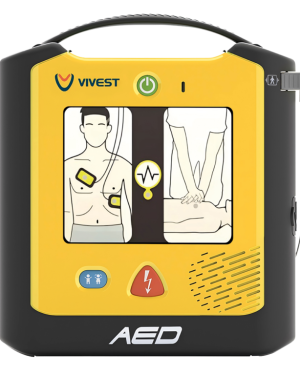
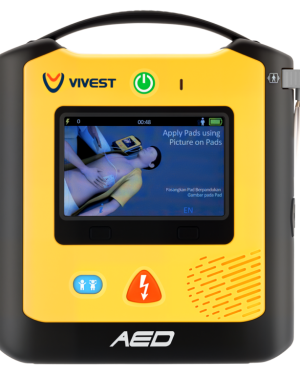
| Rescuer guidance | Voice prompts, pictograms and LED lights | Voice prompts, animations and text on a 5-inch colour screen |
| Language button | – | Yes, switch between up to 3 languages |
| Child mode | Yes, paediatric button (50J) | Yes, paediatric button (50J) |
| Adult energy | 150J biphasic | 150J biphasic |
| Rhythm analysis | Typically 7 seconds | Typically 7 seconds |
| CPR coaching | Metronome and hand placement | Metronome and hand placement |
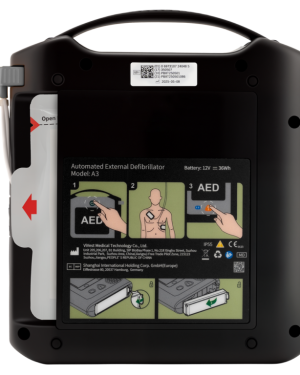
| Pads | Universal adult/child, 5-year shelf life | Universal adult/child, 5-year shelf life |
| Battery | 5-year standby, around 200 shocks | 5-year standby, around 200 shocks |
| Durability | IP55, drop tested to 1.5m | IP55, drop tested to 1.5m |
| Size and weight | 23.2 × 20.9 × 5.9cm, 1.5kg | 23.2 × 20.9 × 5.9cm, 1.5kg |
| Warranty | 8 years | 8 years |
| Price | £995 + VAT | £1,200 + VAT |
Both models share the same pads, battery, shock energy and housing. The difference is how they guide the rescuer: pictograms on the A1, a colour screen on the A3.
What is an AED defibrillator?
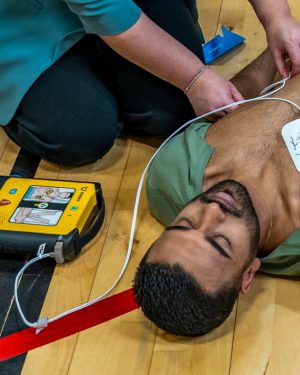
An automated external defibrillator (AED) is a portable device used during sudden cardiac arrest. Pads placed on the chest let it check the heart’s rhythm and, if needed, deliver an electric shock to help restore a normal rhythm.
ViVest AEDs are semi-automatic: the device analyses the rhythm and tells the rescuer when to press the shock button. If no shock is needed, it will not advise one, and it will coach the rescuer through CPR instead.
Do you need training to use a defibrillator?
No. Anyone can use an AED by following its voice prompts, although training helps staff act with confidence. Once installed, register your defibrillator on The Circuit, the national defibrillator network, so the ambulance service can direct 999 callers to it.
Where are defibrillators needed?
- Offices
- Schools
- Gyms & leisure centres
- Care homes
- Shops
- Factories & warehouses
- Transport hubs
- Community buildings
Need help choosing a defibrillator?
Tell us where your AED will be used and how many sites you need to cover, and we’ll help you choose the right model.